How can I make sure my Marketplace plan will still cover my doctor next year?

In this article
If you want to keep seeing the same doctor next year, don’t assume they’ll still be covered by your Marketplace health plan. Provider networks can change from one year to the next – even if you keep the same health plan.
And if you’re switching plans for 2027 – whether it’s because your insurer is leaving the Marketplace or you’re shopping for better coverage or a lower premium – it’s especially important to check whether your doctors are in-network before you enroll.
Here’s how to check whether your doctor will be covered – and what you can do if none of the Marketplace plans in your area include your doctor in their network.
Can I keep my doctors if I need to buy a new health plan?
You might be among the hundreds of thousands of Marketplace enrollees whose carriers are leaving the Marketplace at the end of 2026, meaning you’ll definitely be in a new plan for 2027. Or you might be shopping around during open enrollment in an effort to lower your premium, improve your benefits, or both. Or you might prefer to keep the same plan for 2027, but your doctor might be leaving the plan’s network.
In any of those circumstances, you’ll want to try to find a plan that lets you continue to have in-network access to your doctor. But you might also find that no Marketplace plans in your area have your doctor in their network. If that’s the case, you can continue to see your doctor and pay the out-of-network costs yourself, or you can switch to a different doctor.
Note: Some Marketplace plans offer out-of-network benefits, but these are fairly rare and aren’t available at all in many states. Nearly eight out of ten Marketplace plans are EPOs or HMOs, which do not provide any out-of-network benefits unless it’s an emergency.
What does it mean for a doctor to be in-network?
If your doctor is in-network with your health plan, it means your doctor is among the providers who have signed a contract with your plan, agreeing to accept pre-negotiated rates for the services they provide.
So although the doctor’s regular prices might be higher, they agree to write off the difference between what they charge and what the plan has negotiated for a particular service. And they also agree to follow various plan rules, such as obtaining prior authorization for certain services and following the plan’s requirements for claims submissions.1
How can I find out if my doctor is in-network?
If your Marketplace plan is ending and you have to pick a new plan, the provider network will be an important part of your selection process, assuming you want to continue to have certain doctors in-network.
Even if your Marketplace plan is available for renewal, you’ll want to double-check the network during open enrollment, to see if anything has changed since the last time you shopped for coverage. Here are the steps to follow when you’re checking to see if your doctor is in-network with the health plans you’re considering:
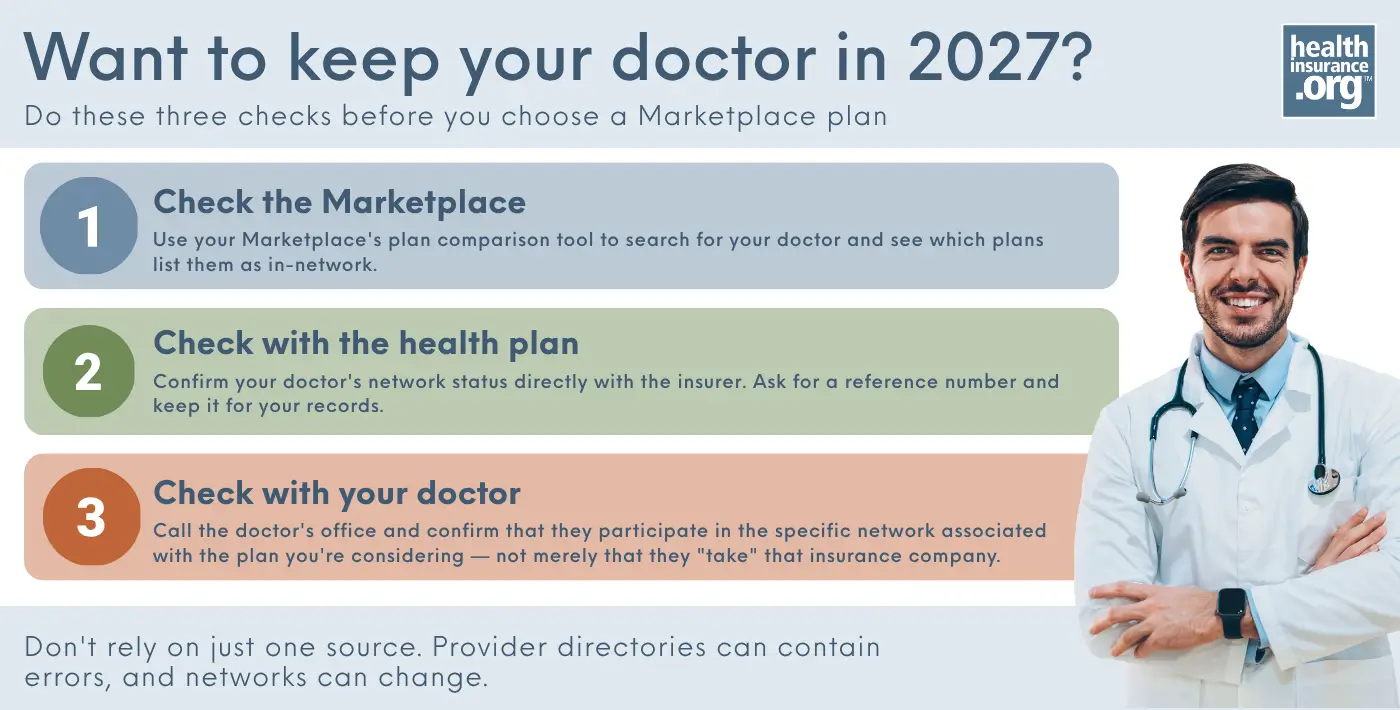
1. Use your Marketplace’s plan comparison tool. The Marketplace is HealthCare.gov in the majority of states, but there are 22 states running their own Marketplace platforms for the 2027 plan year. All of them have a plan comparison tool available on their website. The plan comparison tool allows you to enter names of doctors and other medical providers, and will show you whether the available plans have those providers in-network.
Tip: If you’re using the HealthCare.gov plan comparison tool, after you enter your zip code, age, and income, you’ll reach the screen that shows all available plans. From there, click on “filter plans.” On the next screen, one of the options will be “add providers.” Once you do that and click “continue,” each available plan will have those providers listed under the plan details, with either a green check mark or a red X next to each provider, indicating whether they’re in-network or not. The state-run Marketplaces have similar tools, although the details vary slightly from one state to another.
2. Confirm that your doctor is in-network. Provider network directories sometimes have errors,2 which is why it’s important to double-check with both the health plan and the doctor’s office. You can visit the health plan’s website to see its online provider directory, or you can call the health plan and ask the representative to check whether a certain doctor is in-network.
Tip: It helps if you know the doctor’s National Provider Identifier (NPI), which your doctor’s office can provide. And be sure to get a reference number for the call and write it down, so you have a record of having the provider’s network status confirmed by your health plan.
3. Ask your doctor to confirm they’re in-network. Again, because provider network directories can be inaccurate, you’ll also want to call your doctor’s office to ask them whether they’re in-network with the plan or plans you’re considering.
Tip: An insurer will often have different networks for different types of coverage (Medicare, employer-sponsored plans, individual-market plans, etc.). So for example, you can’t just ask the doctor’s office, “Do you take Blue Cross Blue Shield?” because the Blue Cross Blue Shield entity in your area might have several different networks across various lines of business. You’ll need to ask about the name of the network that’s associated with the specific plan you’re considering, which you can find on the health plan’s website.
Depending on the Marketplace plans that are available in your area and the specific medical providers you see, it may or may not be possible to find a plan that has all of your providers (doctors, as well as preferred hospital, pharmacy, etc.) in-network. If that’s the case, you might consider prioritizing which medical providers are most important to you, and which ones might result in the least amount of care disruption if you need to change doctors. For example, if you’re in the middle of cancer treatment, securing a plan that includes your oncologist in-network is likely a priority.
Check with the doctor’s office to see if they know of any impending changes to their network participation. If they’re leaving the network in a few months (and they already know about this change and can share it with you), that’s useful information that will help you narrow down your plan options for the coming year.
What can I do if my doctor is out-of-network?
If your doctor is out-of-network, your Marketplace health plan likely won’t cover care you receive from that doctor. There’s an exception for emergencies, but most Marketplace plans do not cover out-of-network care in non-emergency situations.
If you have a Marketplace plan that does cover out-of-network care, make sure you understand how the coverage works, how much your out-of-pocket costs will be, and how much the doctor is likely to balance bill you. Depending on the policy specifics, you might find that your plan pays little or none of the cost of seeing your out-of-network doctor (for example, if the costs are counted toward an out-of-network deductible and you don’t get enough out-of-network care to reach that deductible).
It’s also important to understand that even if you confirm during open enrollment that your doctor is in-network with your plan, providers can leave health plan networks mid-year.3
But you might have some protections under the No Surprises Act (NSA) if your doctor leaves your plan’s network. Under the NSA, if you’re considered a “continuing care patient,” you might be eligible for an extra 90 days of in-network coverage with your provider, even after they’re no longer in-network. Continuing care patients include those who are:4
- being treated for a serious and complex illness,
- receiving inpatient or institutional care,
- scheduled for non-elective surgery,
- pregnant and receiving medical care for the pregnancy, or
- terminally ill.
But even if you qualify under the “continuing care” rules, you’ll need to consider whether your care needs are likely to continue for more than 90 days. If so, you’ll have to decide whether to keep your current doctor (and if so, how much your out-of-pocket costs will be) or find a new one. If you’re planning to find a new one, you’ll want to start that process as soon as possible, in case the in-network doctors don’t have any immediately available appointments for new patients.
Your doctor leaving your plan’s network won’t trigger a special enrollment period. So unless you qualify for a special enrollment period for another reason, you’ll have to wait until open enrollment to switch to a different plan. At that point, you’ll be able to consider all of the available plans to determine if there’s another option that will be a better overall value. Learn more about how to choose a health plan.
Footnotes
- “What are medical insurance contracts? Key Terms, Types, and How They Work” Contracting Providers. Feb. 16, 2026 ⤶
- “Inaccuracies in provider directories persist for long periods of time” National Library of Medicine. June 4, 2024 ⤶
- “How Your In-Network Health Coverage Can Vanish Before You Know It” KFF Health News. Mar. 15, 2024 ⤶
- “Action Plan: Doctor going out-of-network” Centers for Medicare & Medicaid Services. Accessed Sep. 8, 2026 ⤶